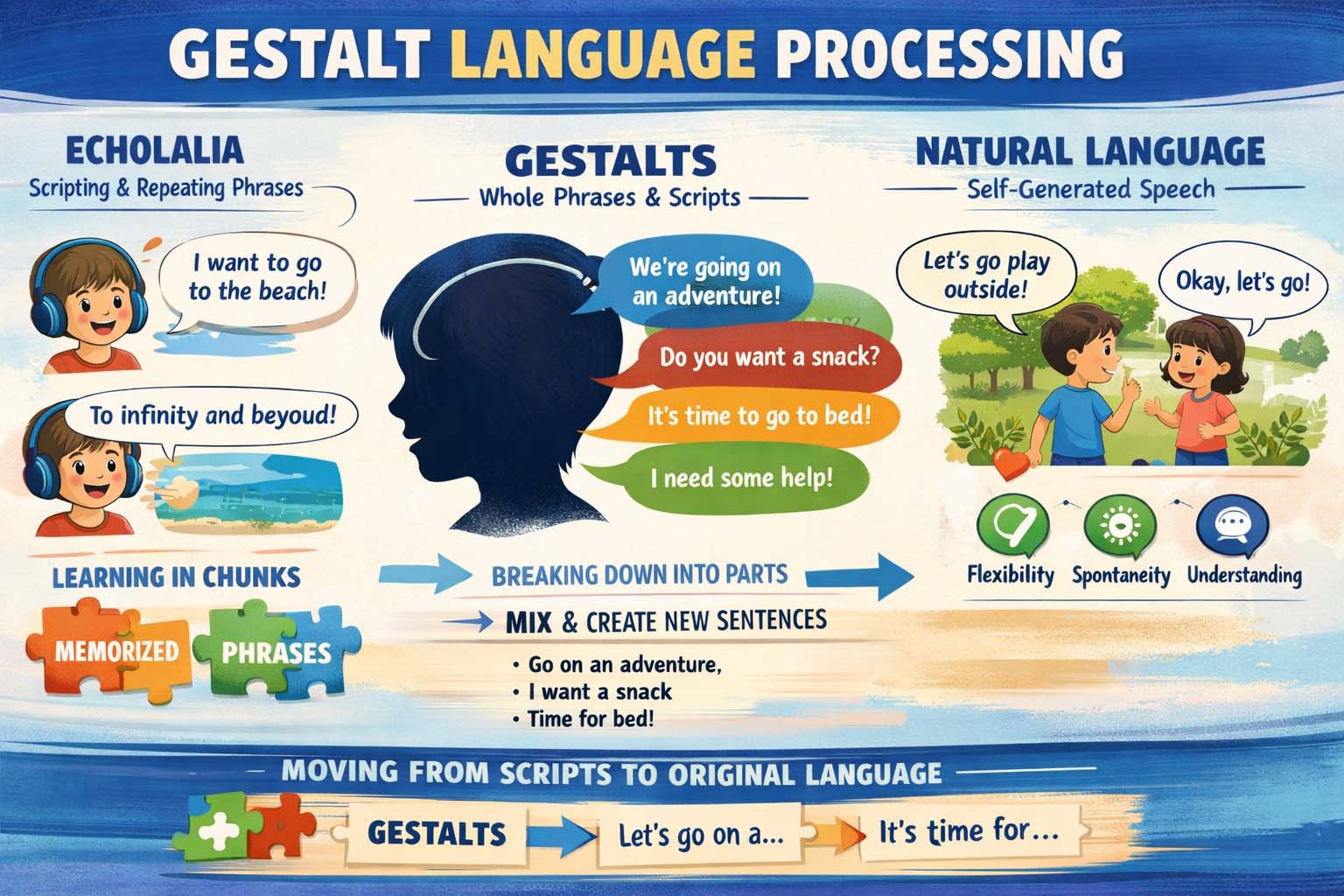
Language development happens in different ways for different people. While many children learn speech word by word, others learn language in larger chunks or scripts. This style of learning is known as gestalt language processing. In recent years, the topic has gained attention among parents, educators, speech therapists, and caregivers who want to better understand communication development.
Gestalt language processing is not a disorder. It is a natural language-learning style where a person first understands and uses phrases, sentences, or memorized scripts before breaking them into smaller parts. Many children, including some autistic children, may learn language this way.
In this article, we will explore gestalt language processing, how it works, the stages of development, benefits, and supportive strategies.
What Is Gestalt Language Processing?
Gestalt language processing refers to learning language in “whole chunks” rather than single words first. time like “juice,” “go,” or “play,” a child may first say full phrases such as:
- “Do you want juice?”
- “Let’s go outside!”
- “Time to clean up!”
These phrases may come from parents, teachers, favorite shows, songs, or repeated daily routines.
Over time, the learner begins to understand the smaller parts inside those phrases and starts creating new combinations of language.
Meaning of the Word Gestalt
“pattern. In language development, it means the learner first understands language as complete units rather than separate words.
For example:
Instead of hearing “I want cookie” as four separate words, the learner may hear it as one meaningful phrase connected to getting a snack.
This is why gestalt language processing can look different from traditional speech development.
How Gestalt Language Processing Works
Children who use this style often memorize phrases linked to emotions, routines, or experiences. They may repeat lines exactly as they heard them because the phrase carries a complete meaning.
Examples include:
- “It’s bath time!”
- “Ready, set, go!”
- “Oh no, not again!”
- “Can I have some please?”
These scripts are often meaningful communication attempts, even if they sound repeated or copied.
As development continues, the child starts mixing phrases, shortening them, and eventually generating original speech.
Stages of Gestalt Language Processing
Many speech professionals describe several stages of development.
Stage 1: Whole Scripts
The child uses memorized phrases exactly as heard.
Examples:
- “Let’s get out of here!”
- “You did it!”
Stage 2: Mitigated Phrases
The child begins changing scripts slightly.
Examples:
- “Let’s get juice!”
- “You did it fast!”
Stage 3: Breaking Into Parts
Smaller language pieces begin to emerge.
Examples:
- “Want juice”
- “Go outside”
Stage 4: Simple Original Sentences
The child creates new combinations.
Examples:
- “I want juice.”
- “I go outside now.”
Stage 5+: More Complex Grammar
Language becomes flexible and more natural over time.
These stages may not always happen in a perfect order, and every learner develops differently.
Who Uses Gestalt Language Processing?
Gestalt language processing can occur in many children, but it is often discussed in relation to autistic children. Some children naturally process patterns, routines, and repeated phrases strongly, making chunk-based learning more common.
However, not every autistic child is a gestalt language processor, and not every gestalt language processor is autistic.
It is simply one of many natural ways humans learn communication.
Signs of Gestalt Language Processing
Some common signs may include:
- Repeating phrases from movies or shows
- Using full scripts instead of single words
- Echoing language heard earlier
- Strong memory for songs or routines
- Delayed spontaneous single-word use
- Gradually changing repeated phrases into original speech
These signs should be interpreted carefully by qualified professionals, not as labels on their own.
Benefits of Gestalt Language Processing
This language style has many strengths.
Strong Memory Skills
Many learners remember songs, routines, and phrases easily.
Fast Meaningful Communication
Using phrases can express needs quickly.
Emotional Connection
Scripts are often tied to comforting routines or positive experiences.
Creative Language Growth
Once phrases are broken apart, learners may build language in unique ways.
Understanding strengths helps families support communication confidently.
How to Support a Gestalt Language Processor
1. Model Useful Natural Phrases
Use short meaningful phrases during routines.
Examples:
- “Time for snack.”
- “Let’s go outside.”
2. Avoid Excessive Correction
Instead of forcing word-by-word speech, support communication naturally.
3. Expand Their Language
If they say “Let’s go!” you can model:
- “Let’s go park!”
- “Let’s go outside!”
4. Use Repetition in Daily Routines
Consistent phrases during meals, play, bath time, and bedtime can help.
5. Work With a Speech Therapist
A qualified speech-language pathologist can guide individualized support.
Common Misunderstandings
It Is Not “Just Repeating”
Repeated scripts often carry real meaning.
It Is Not Wrong Language Learning
It is a different developmental pathway.
Many gestalt learners become flexible communicators over time.
Why Awareness Matters
When adults misunderstand this learning style, they may think the child is not communicating. In reality, the child may be using phrases intentionally.
Recognizing gestalt language processing can reduce frustration, improve support, and encourage respectful communication development.
Gestalt Language Processing and Therapy
Speech therapy may focus on:
- Understanding scripts as communication
- Building flexible phrase combinations
- Supporting comprehension
- Expanding spontaneous language
- Encouraging connection through play and routines
The best therapy is personalized and supportive rather than forcing one method.
Final Thoughts
Gestalt language processing is a natural language-learning style where a person learns communication in whole phrases before breaking language into smaller parts. Instead of starting with isolated words, learners often use meaningful scripts connected to routines, emotions, or experiences.
With patience, understanding, and proper support, gestalt language processors can continue developing flexible and effective communication skills. Every child learns differently, and recognizing those differences is an important step toward inclusive and successful language growth.